 TR
 EN
 RU
 FR
 ES
 AR
 SR
Basalt Crushing and Screening Plant Selection Guide

Basalt Crushing and Screening Plant Selection: What Should the Right Equipment Configuration Be?
The most critical step in crushing and screening plant projects is selecting equipment suited to the physical and chemical characteristics of the processed rock. Volcanic in origin, with a hardness rating of 6-7 on the Mohs scale and a high silica (SiO2) content, basalt is among the most abrasive minerals.
Therefore, instead of standard crushing plants, it is essential to prefer specialized plant architectures featuring high wear resistance, correct configuration, and low operating costs.
Main Equipment Configuration in Basalt Crushing and Screening Plants
The key machines and technical selection rationales required for an efficient and uninterrupted basalt crushing-screening line are as follows:
1. Vibrating Feeder
In the primary stage, vibrating feeders that transfer run-of-mine (raw) basalt rocks into the crushing and screening plant must be built to withstand the casting impacts of construction machinery and the abrasive effect of large rock blocks. Additionally, a bypass (grizzly) unit must be integrated into the feeder to separate coarse soil mixed with the basalt before it enters the crusher.
2. Primary and Secondary Crusher Selection
- Primary Stage (Jaw Crusher): Thanks to its wide jaw feed opening, it easily grips large run-of-mine basalt blocks. It is an indispensable part of the primary stage with its high capacity, low maintenance cost, and high crushing performance on hard rock.
- Secondary Stage (Cone Crusher): For crushing hard and high-silica basalt, cone crushers are the ideal solution instead of impact crushers. They operate on an eccentric compression principle between the mantle and concave. Although initial investment costs appear higher, they yield the most economical results in the long run with low operating and wear part costs.
3. Tertiary Stage
In abrasive basalt crushing operations, conventional tertiary impact crushers cause excessive spare parts costs due to rapid wear on blow bars and impact plates. Therefore, a Vertical Shaft Impact Crusher (VSI) should be preferred in the tertiary stage.
- Crushing Principle and Advantage: VSI crushers operate on the "stone-on-stone" crushing principle. A high-speed rotor accelerates and hurls the rock against a rock lining formed inside the crushing chamber. This minimizes wear part costs while producing high-quality cubical 0-5 mm fine material (sand).
4. Screen and Belt Systems
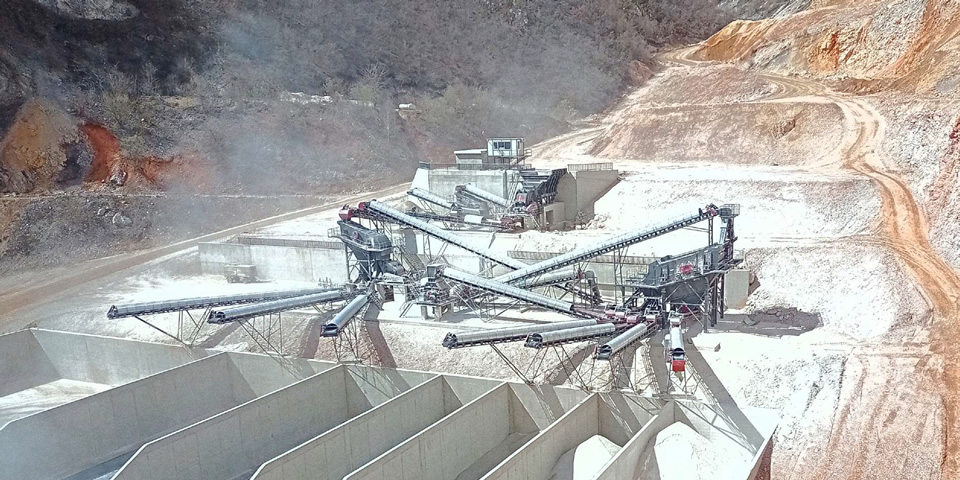
Screens and conveyor belts work in an integrated manner to classify crushed basalt into target grain sizes and maintain continuous material flow throughout the plant:
- Vibrating Screens: Due to the high abrasiveness of crushed basalt, screen bodies, discharge chutes, and material contact points must be lined with wear-resistant armor plates (HARDOX lining). The number of screen decks and mesh openings are specifically tailored to the final product sizes required by the project (gravel, aggregate, 0-5 mm sand).
- Conveyor Belts: Conveyor belts providing material circulation between crushers and screens are exposed to continuous impacts from tons of heavy, sharp-edged basalt stones. Therefore, stockpile and return conveyor belts used in the plant must feature heavy-duty structural frames, and belt rubber must be selected from multi-ply materials resistant to cuts and abrasion.
Common Mistake: Why Should Impact Crushers (Primary / Secondary Impactors) Not Be Used for Basalt?
The biggest mistake frequently made in the industry is choosing a secondary impact crusher for abrasive plants like basalt in order to keep initial investment costs low. While impact crushers exhibit high performance in soft rocks like limestone, in basalt they cause blow bars and impact plates to wear out in a very short time, multiplying your operating costs.
Engineering and Research Process for the Right Plant
Every basalt quarry differs in hardness, density, and moisture content. Therefore, a successful crushing and screening plant is not achieved merely by purchasing machinery; it requires site analysis, laboratory testing, engineering design, and correct layout planning.
Delivering high-efficiency plants to the mining and construction sectors since 1976, General Makina offers basalt crushing and screening solutions specifically designed for your site and project with its expert engineering team. You can contact us to receive project-specific engineering support.